Political campaigns run on momentum. A candidate who dominates social media in August can still lose in November if their supporters never show up at the polls, never donate past a first gift, and never bring a neighbor along. Momentum has to be built deliberately, touch by touch, over weeks and months. That’s where the inbox becomes some of the most valuable real estate a campaign can own.
Reach Voters, a full-service political digital marketing agency based in Miami with over 15 years of experience, builds targeted email marketing campaigns and direct mailing programs that keep voters informed, strengthen relationships, and drive measurable results before Election Day. Their work across South Florida races, from congressional contests to county commission seats, shows what happens when campaigns treat email not as a broadcast tool but as a conversation channel.
This article breaks down how that approach works, and what your campaign needs to do the same.
 Why Email Still Outperforms as a Digital Strategy
Admit it, at least one or two people at your campaign planning meeting rolled their eyes when “email” came up as a strategy. To them, it feels antiquated. It sounds like something their favorite representative’s grandfather relied on. The rest of the room is fixated on TikTok numbers.
What they don’t get is that email still outperforms every other digital channel in political campaigns, social media included.
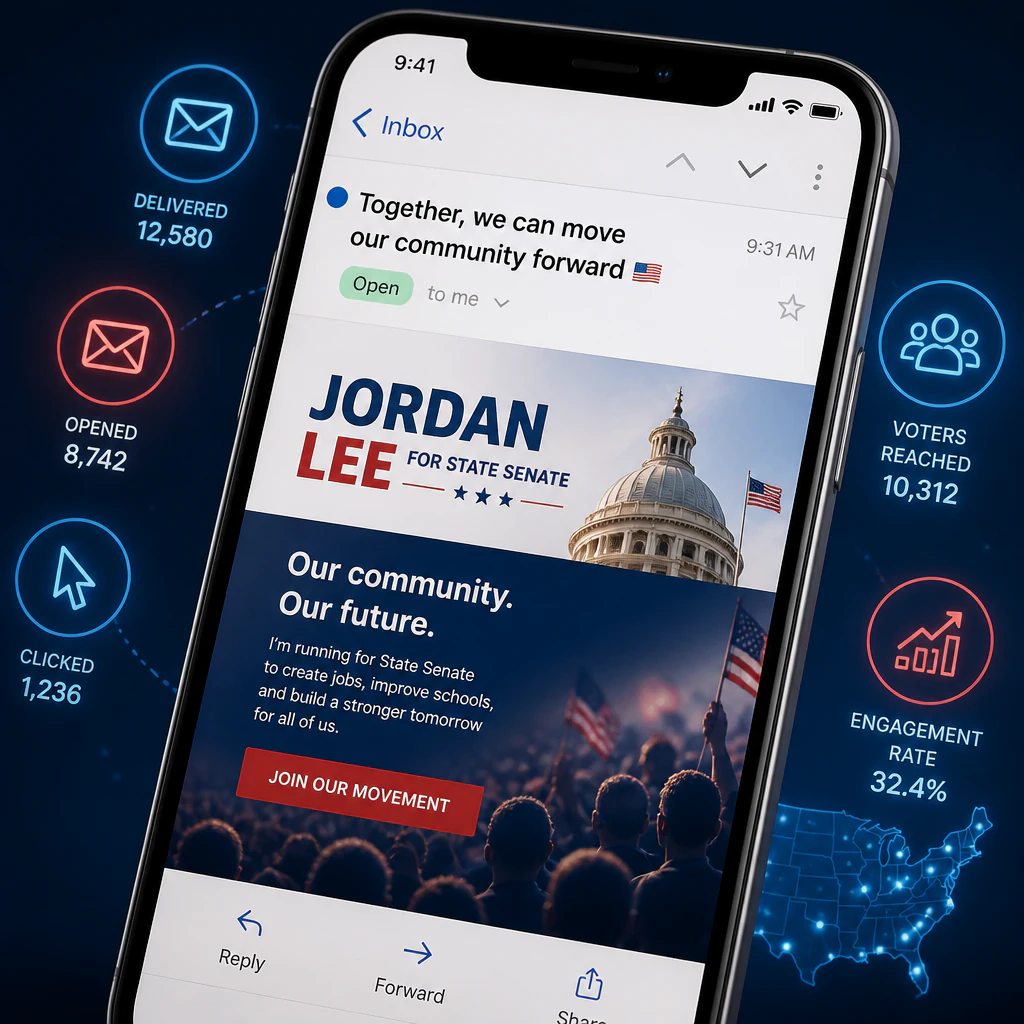
Unlike a social media post that only 3 percent of your fans might ever see, the email you’re sending ends up in someone’s inbox, without the algorithm weighing in on its importance or a budget needed to boost the post. Email reaches those people who have opted into receiving your content. When organic social media starts failing to deliver, as is likely in the final months of a campaign season, having this direct line to your constituents is more important than the vast majority of campaigns understand.
The Pew Research Center confirms that over 90 percent of U.S. adults are online, and email remains the most ubiquitous use of the internet. No single social media platform can match email’s penetration, especially across generations.
With a quality list, email’s cost per contact is a fraction of what you’d spend on direct mail, social media, paid digital, or phone banking. The differential translates directly into dollars that can be allocated to paid persuasion and voter contact, which is where your dollars matter the most.
Build Your Email List: The Email Marketing Strategy Every Campaign Needs
It’s a hard pill for some campaigns to swallow, but a list of 500 people you know actually want to hear from you will crush a list of 5,000 unknown email addresses.
It isn’t just philosophy; technically speaking, having a low number of email bounces and spam complaints is critical to maintaining sender reputation. Without a quality sender reputation, your email gets flagged as spam. It never arrives in anyone’s inbox. Nobody sees it. So, how should campaigns build an email list?
Build your email list around people who already want to engage.
The opt-in form should appear on the campaign’s key pages, especially the homepage and donation page, since the people landing there came intentionally. Landing pages tied to a petition, a pledge, or downloading a resource also outperform a generic online form requesting to be added to a list. At every in-person event—a town hall, a rally—the people in the room are already engaged, so collect their information and add them to the list. By definition, these are warm contacts.
Target social traffic to email signups. Promoted posts (both paid and organic) for your email list perform better when they’re offering something specific, like “Be the first to hear our new housing affordability platform” rather than “sign up for our updates.”
Use voter file data responsibly. Most campaigns have access to voter files that give you a great jump-start on your list. However, you want to make sure you’re warming up those contacts, ideally in a dedicated welcome series, before you make a hard ask. Don’t blast cold voter data like they’ve been following the campaign for months.
Look at lists of aligned organizations. Sometimes you’ll find that endorsing groups, issue-based organizations, and aligned PACs will cross-promote to their own lists. A single mention in a marketing email to an aligned list that really resonates with the candidate can result in hundreds of new, interested email subscribers overnight.
There is one golden rule: do not purchase a commercial email list. Do not ever do this. List providers who sell commercial email lists produce terrible email deliverability, are often in violation of email service provider terms of service, and you will do irreparable damage to the deliverability score of the emails coming from your address. The few hundred new contacts are not worth the damage to your email marketing program.
Types of Marketing Emails to Send: Welcome Email, Email Newsletters, and More
A common mistake campaigns make is treating every single email like a fundraising email. If you only send emails asking for money, people will train themselves to ignore them. Successful email marketing programs understand the value of variety.
Send a Welcome Email. A welcome email is perhaps the single most underutilized tool in a campaign’s arsenal. The open rates on welcome emails are always some of the highest, yet so many campaigns waste this opportunity with a generic “Thanks for signing up.” A good welcome email briefly introduces the candidate, tells new subscribers how often they’ll hear from the campaign, and makes a non-monetary ask—following on social media or signing the candidate’s pledge. Hold the fundraising pitch for now; this email is about starting the relationship.
Send Regular Email Newsletters. Regular email newsletters help keep the list engaged when fundraising appeals are less frequent. Policy briefings, responses to local events, and election results and developments help build the relational equity that makes a donation ask land when you actually do send it.
Send Fundraising Emails. Fundraising emails remain the core of a campaign’s email arsenal, but they need to be crafted with care. Focus the email around a specific story of what the funds are actually going to be used for. Be sure to establish a sense of urgency with a deadline or a goal. Make the call to action easy. Consider a multi-email series built around a matching gift deadline, for example, rather than a one-off email.
Send Volunteer/Mobilization Emails. Volunteer asks are slightly different because people are being asked for their time rather than their dollars. It has to read like a one-on-one personal invitation, not a form email that got sent to 10,000 people at once.
GOTV emails sent during the few days before Election Day are some of the most important things a campaign does. Polling place locations, hours, and early-voting reminders—these are the automated emails worth their weight in gold. This sequence must be developed and tested ahead of the final week, not in the final week.
Post-action confirmation emails often get ignored. A confirmation email sent after someone donates or signs up to volunteer is a prime opportunity to reaffirm their action and promote other ways to get involved. These transactional emails should not be a mere receipt.
Email Marketing Best Practices: Cadence, Timing, and Segmenting Your List
If you’re not emailing enough, people don’t remember who you are. If you email too much, people unsubscribe, or worse, mark you as spam. The ideal cadence changes depending on the time of year: you want about one to two emails a week for most of the cycle, and up to three to five emails a week for the final three to four weeks before Election Day.
It’s also important to time things correctly. Tuesdays, Wednesdays, and Thursdays are typically better days for political email than Mondays. Emails sent between 9 a.m. and noon in the subscriber’s own time zone typically get the best open rates—far better than evening sends. Still, watch your own numbers, since factors like age and location can shift what works for your audience.
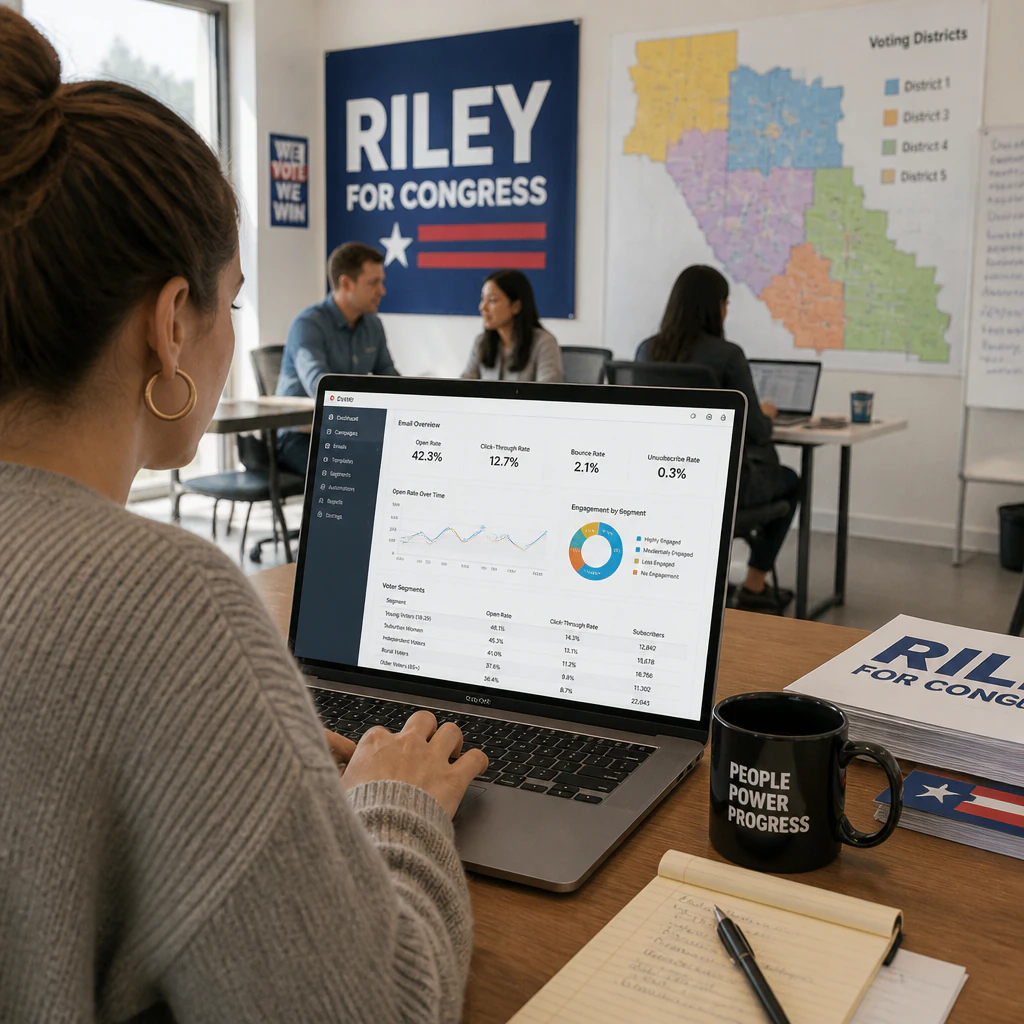
However, by far the most powerful approach is to segment your email list and send different types of emails to different types of people. Campaigns that send the same email to everyone are leaving valuable results on the table. The email that goes to a person who has donated three times should be different from the email that goes to a person who has only come to one event. The email that goes to a person in a highly competitive battleground precinct is different from the email that goes to a person in a district that has already been won.
Reach Voters leans on this kind of data-driven targeting, because the difference between actually reaching a voter and just sending an email comes down to that specificity.
Marketing Automation: Reaching Supporters at Scale
Today’s email marketing platforms are making it possible for campaigns to do what would have required a full-time employee just ten years ago. They’re able to automatically send the right message to the right person at the right time based on what that person did.
The most important email automation sequences:
A new subscriber sequence that runs for the first two weeks should build the relationship before the ask ever comes. The first email is the welcome email. The next email should be about the candidate’s background or life story. The next should be their stand on an important issue. Then, by the time email four or email five asks for a donation, the subscriber has already engaged with the campaign multiple times. That shifts how the request lands.
A post-donation email series that goes beyond the basic confirmation email increases the odds of getting a second gift. Providing an impact statement 48 hours after giving, detailing exactly what it’ll buy, and then inviting them to volunteer achieves something most campaigns never try: proving to donors that their gift actually meant something.
A re-engagement email campaign for people who haven’t engaged in 90 days or longer either reactivates them or identifies people who need to be removed from a campaign’s list. Holding on to dead contacts may feel like protecting your list size, but it steadily drags down your email metrics over time.
Automation should feel like attentiveness to your supporters, not like you’ve automated the relationship—and that comes down mostly to the writing.
 Email Deliverability: Making Sure Your Emails Actually Land
This is where campaigns run into trouble. They build out a solid, engaged audience, write solid emails, and then, come October, find that their emails aren’t delivering well. There’s just not enough time to recover at that point.
This is the backend of everything we talked about above, and running a campaign with this kind of issue in the final stretch isn’t just a problem; it’s a risk.
- Authenticate your email domain. SPF, DKIM, and DMARC records tell inbox providers you’re legitimate and not some spammer. This step is non-negotiable.
- Clean your email list regularly. Remove hard bounces immediately. Suppress anyone who hasn’t opened an email for 120+ days unless you’re in an active re-engagement. A smaller email list always outperforms a bloated one without exception.
- Use email software built for volume. Free tools cap how many emails you can send at once and run on shared servers, so other users’ behavior drags down your own sender reputation. Use a provider designed for larger audiences.
- Write subject lines like human beings do. Nobody opens emails in ALL CAPS loaded with excessive punctuation and misleading preheaders—they just put recipients off. The more people who open your email, the more likely it is that inbox providers will deliver your emails to the inbox instead of the spam folder.
- Unsubscribing has to be easy. The CAN-SPAM law dictates that it must be easy to opt out of emails. It’s much better to have someone voluntarily unsubscribe than to have someone simply mark your email as spam in their inbox.
Email Doesn’t Work Alone: How It Fits Your Wider Marketing Mix
Email marketing campaigns that achieve the best results use email as the glue holding the remaining pieces of their marketing mix together, instead of relying on email as its own standalone channel.
A supporter is far more likely to take action after seeing a specific social media ad, then receiving an email that follows up the next morning, then seeing a direct mail piece a couple of days after that, than if they only encountered one of these marketing tactics. Every channel supports the others, but email newsletters are responsible for the heavy lifting when it comes to the hard sell with undecided voters or soft opposition supporters who need weeks of consistent, thoughtful exposure to move.
Reach Voters’ campaigns for Maria Elvira Salazar for Congress and Raquel Regalado for County Commission, for example, demonstrate how email can be used as part of a cohesive program that combines social media, paid digital, and direct mail, instead of as a siloed channel.
Get Started with Email Marketing: How to Build an Effective Campaign from Day One
There has never really been a question of whether a campaign needs to use email. The real question is how the campaign needs to build out email infrastructure and operations in order to reap real gains.
Starting from nothing means deciding on an email service provider appropriate for political and high-volume marketing purposes, making sure your campaign website has an opt-in form, drafting a multi-message welcome sequence that focuses on getting people acquainted with the campaign before asking anything of them, and making sure you have a content calendar that includes a minimum of one newsletter per week for the rest of the campaign.
Already in the game and still not getting the results you want? The biggest missing pieces in most campaigns are almost always the same. Most candidates aren’t sending personalized messages (segmentation), campaigns are manually sending messages (no automated email workflows), and there’s no program for maintaining clean data (list hygiene). Addressing these three gaps usually leads to measurable increases in click-through and conversion rates quicker than any other effort.
The Reach Voters team has been putting together and executing successful email marketing campaigns for competitive Florida races long enough to know what works and what doesn’t when every day counts and every margin is critical. We bring that experience to every political marketing program—it isn’t just a set of tools, it’s a deliberate effort to reach the right people with the right message at the right time.
We can help you build out a more organized email marketing strategy. Let’s talk.